22 Jan, 2026
Traditional
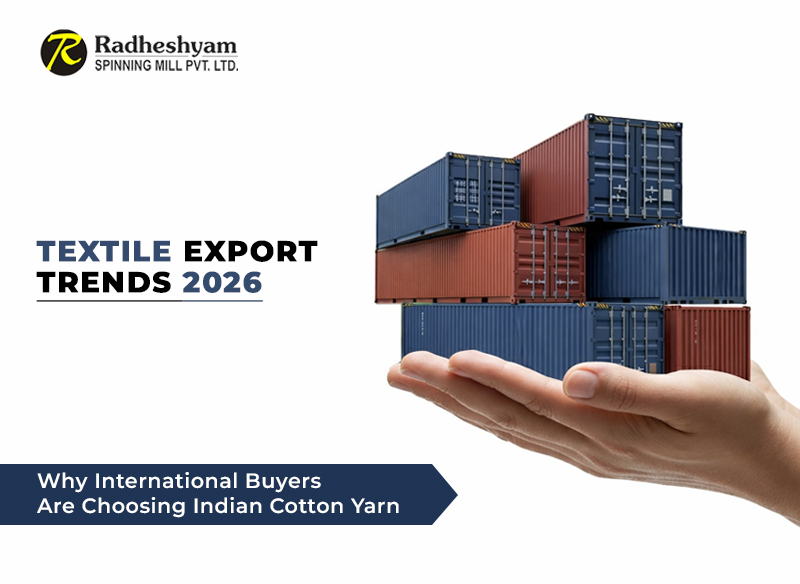
Textile Export Trends 2026: International Consumers are Favoring Cotton Yarn from India
By: Radheshyam Spinning | 18 Feb, 2026
As we enter the year 2026, the world is observing a paradigm shift in the textile industry, influenced by the demands in the sector coupled with trade forces and the need to excel in sustainability. Behind this evolution stands the Indian cotton yarn, the most in demand material in the overseas market in a never ending stream of consistency. The Indian cotton yarn market has ceased to remain an option for textile producers, traders, and selectors in the overseas market but has rather become an ally in this task.
We, at Radheshyam Spinning Mill, can aptly observe these transitions. Our dealings with international buyers help us understand why the Indian yarn market shines in the global market. There are a number of key factors in the year 2026 that define the global preference for the Indian yarn market.
1.Unmatched Quality Combined with Technological Advancements
The key to Indian success in exporting cotton yarn has been its superior quality all along. India has a long and illustrious history of growing cotton, thanks to its advanced ginning and spinning infrastructure meeting international standards for quality. Contrary to commodity manufacturers, who produce standardized yarn, Indian spinning units are at the forefront in adopting latest innovations in areas such as open end, ring, and automated quality measurement systems in winding machines.
These innovations provide a constant yarn count and tensile strengths with low variation rates. This will be highly appreciated by the global manufacturers of textiles. Nowadays, the buyer not only wants to purchase a yarn but a reliable textile with guaranteed performances from shirting to technical knit.
Moreover, the flexibility of Indian mills in supplying a wide range of counts fine, medium, and compact cottons enables industries to produce various final products. This is one of the reasons why the export position of India’s textiles is improving.
2. Sustainability as a Core Competitive Advantage
“Sustainability has ceased to be a trend. It’s a prerequisite.” By the year 2026, the requirements of buyers in the European, North American, and Asian markets include their growing concerns about the environmental credentials, traceability, and ethical production of the products. Textile manufacturers of Indian cotton yarn have now strengthened their practices in the production process.
There are more spinning mills being certified with recognized sustainability initiatives such as OEKO TEX, Better Cotton Initiative, or Global Organic Textile Standards. These initiatives assure the purchasing company that the said yarn bought does not contain any harmful elements or has been produced in socially responsible environments.
In our Radheshyam Spinning Mill operation, environmentally responsible practices such as water conservation techniques, energy efficient motor use, and recycling techniques that minimize the environment’s effects. This has made environmentally responsible spending less expensive than expected and made environmentally responsible consumers our major attractants. They put the environment at the heart of the supply chain.
3. Competitive Pricing Leveraging Economies of Scale
Global purchasers will necessarily have quality weighed against price, most likely in the highly price sensitive textiles industry. It is because the Indian cotton yarn has established competitiveness by utilizing economy of scales, optimized manufacturing efficiency, and stabilized price structures.
In contrast to smaller suppliers who lack any real negotiation power when it comes to sourcing raw cotton, larger textile clusters in India ensure that their mills are able to quote fixed prices to foreign customers, despite the market being prone to raw cotton price volatility.
Indian cotton yarn suppliers have made themselves desirable partners for the brands by offering value without compromising on the quality of the product.
4. Strategic Geographic Advantage and Improved Logistics
Secondly, another reason for the increased interest of international consumers in the Indian market is the strategic geographical position as well as improved export infrastructural arrangements. It is conveniently situated to meet the demands of Africa, the Asia Pacific region, Asia, as well as the Americas.
In recent years, there has been increased expenditure on port handling, transport, and export facilitation policies, hence increasing shipping efficiency. This is because ports like Nhava Sheva (Mumbai), Mundra, and Chennai can process a larger quantity of shipments faster.
Further, bilateral trade deals, duty incentives, and simplified customs clearance systems have enhanced the competitiveness of Indian exports. The improvement in logistics makes it easy for buyers to reduce lead times, manage inventory effectively, and avoid costly delays that are an important factor in the currently fast moving market.
5. Emphasis on Innovation & Product Differentiation
The textile industry is moving at a rapid pace of innovation, and buyers are increasingly looking for specialty yarns, be it performance wear, technical textiles, and/or fashion segments. The Indian mills are taking up this challenge and providing value added products such as compact yarns, antibiotic yarns, and blends.
Cotton breeders, engineers, and manufacturing specialists have worked in collaboration to provide yarns that exhibit strength, texture, moisture management, and durability. These factors are attractive to brands that are looking to differentiate themselves.
Export statistics reveal a growing trend in both volume and value for specialty cotton yarn shipped from India, which highlights the point that innovation, along with quality, is being highly prized in the worldwide marketplace.
6. Improving Buyer & Seller
In a world where supply chain resilience is a key priority, the value of lasting partnerships is higher than ever. Suppliers from the Indian textiles industry have ensured that trust is established through open communication, flexible delivery of orders, as well as after sales service.
Customers value suppliers for understanding cycles within the market, offering customized supplies as per end use requirements, and ensuring delivery promises. Indian textile millers have relied on the strategy of maintaining such relationships by exceeding the limits of pure transactional dealings and acting as allies for growth.
This service oriented mentality allows the Indian cotton yarn suppliers to be the suppliers of choice among companies that prefer to work with a business that looks to work together towards a common goal.
Conclusion
India’s Dominance in the Global Cotton Yarn Market In drawing out the trend of textiles exported in 2026, one thing remains evident, and that is Indian cotton yarn, which has ceased to be a commodity, as it has become a smart procurement option for foreign importers. Indian yarn, with its efficacy, cost effectiveness, innovative approach, and partnerships, has created a niche in the import sector.
For Radheshyam Spinning Mill, this trend means, of course, not only an increase in exports but also an understanding of the role of India in the progress of the textile future. We are ready to help international buyers with their yarn requirements in light of the current and future demands. While collaborating with Indian suppliers of cotton yarn, global brands and companies are preferring reliability, robustness, and unparalleled value for money, and this trend will continue to shape the textile patterns even after the year 2026.
Recent Posts