18 Feb, 2026
Traditional
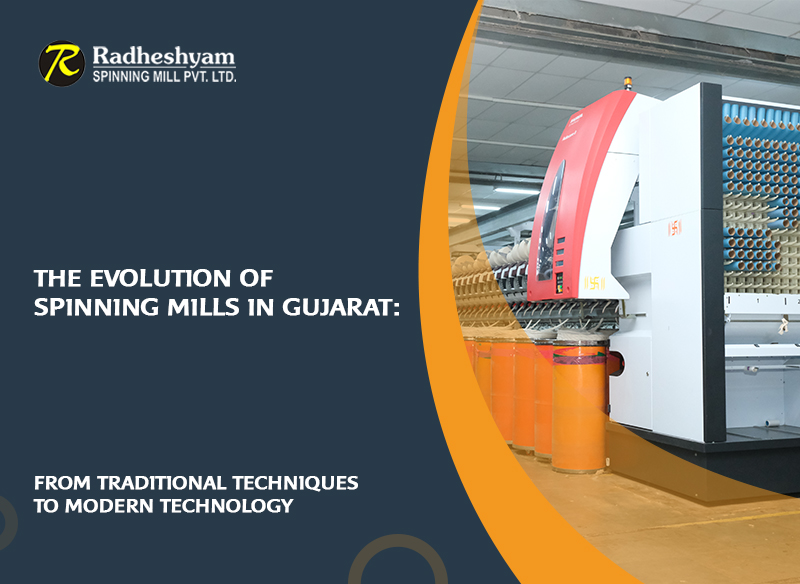
The Evolution of Spinning Mills in Gujarat: From Traditional Techniques to Modern Technology
By: Radheshyam Spinning | 6 Dec, 2025
Gujarat has been termed the backbone of India’s textile industry and has undergone a phenomenal transformation in spinning mills. The path from hand looms and small cottage units to integrated, mechanized spinning mills showcases innovation, persistence and quality emphasis. At Radheshyam Spinning Mill Pvt. Ltd., we are honorably located within the broader history of the textile revolution of one state, Gujarat and honorably, yet poised, for the future of modern spinning mills with technology and sustainability.
The Historical Foundations of Spinning in Gujarat
Historically, the textile tradition of Gujarat was based on household based handlooms, charkhas and small handspinning units in villages and towns. These small units produced coarse cotton yarns; yarns for local consumption or regional trade. Spinning was an artisan process involving manual labor, simple wooden spindles and minimal mechanization. There was a focus on craft, customs, and trade within these regions.
Over time, as a result of consumer demand for finer yarns and larger volumes of production whether due to Indian domestic use or Indian exports, the process of spinning underwent an early phase of mechanization. The early introduction of ring frame spinning, small roller ginning, and early factory processes, was the beginning of the transition from traditional craft to commercial factories.
The Growth of Industrial-Scale Spinning Mills in Gujarat
In the latter half of the 20th century, Gujarat witnessed a textile revolution: massive scale spinning mills were established, especially near Surat, Ahmedabad, Rajkot, and other weaving/knitting centers. Spinning mills involved power operated machines, larger capacity, regularized output and improved supply chain interdependence.
This change lead to the growing significance of the phrase “spinning mills” in Gujarat’s textile lexicon. The phrase came to refer to places that could convert large quantities of raw cotton to yarn, selling in local, national, and international markets.
Key Drivers of Evolution: Technology, Quality & Global Demand
Several important factors propelled the evolution of Gujarat’s spinning mills:
- Technology Adoption: Spinning mills shifted from manual and semi mechanized devices to fully mechanized ring frames, open end spinning machines, compact spinning, autopiecers and automated doffing. These advancements significantly boosted productivity, reduced labor intensity and improved uniformity of yarn.
- Quality Expectations: Global textile buyers increasingly demanded finer counts, consistent quality, lower defects and adherence to standards like OEKO-TEX or GOTS. Gujarat’s spinning mills had to step up to meet these stringent standards.
- Supply Chain Integration: From cotton sourcing and ginning to spinning, package dyeing and shipping, an integrated approach became essential. Mills located in Gujarat benefited from proximity to ports, clusters of weaving/knitting units and supportive infrastructure.
- Sustainability and Efficiency: Energy efficiency, water conservation, waste management and eco friendly practices became more prominent. The new generation spinning mills in Gujarat don’t just spin yarn; they spin responsibly.
Radheshyam Spinning Mill: Embodiment of Evolution
At Radheshyam Spinning Mill Pvt. Ltd., we represent this very journey from regional tradition to state of the art spinning mill. Since our inception in 2011, our promoters, with over 30 years of experience in the cotton industry, have upheld a strong tradition of quality, reliability, and customer focus.
Salient aspects of our evolution and current capabilities include the following.
- Quality sourcing of cotton: We use only the best cotton to ensure consistent yarn quality.
- Modern product range: We offer open end cotton yarn in sizes ranging from NE 6s to 30s, including denim yarns, non denim yarns, knitted yarns and terry towel yarns.
- Rigorous quality control: Emphasizing quality assurance, advanced machinery, and adherence to industry standards, our facility delivers on meeting the demands of international markets.
- Global market reach: Not only serving domestic textile clusters, but also exporting to global yarn market embodying the modern paradigm of spinning mills in Gujarat.
These attributes make Radheshyam Spinning Mill Pvt. Ltd. a modern example of how far Gujarat’s spinning infrastructure has come from regional craft to global competition.
Modern Technology: What Sets Today’s Spinning Mills Apart
In today’s context, the spinning mills of Gujarat and indeed across India are defined by:
- Advanced Spinning Machines: This includes compact ring spinning, open end spinning, rotor spinners with high speeds and improved yarn properties.
- Automation & monitoring: Computerised process control, yarn real time monitoring, automatic doffers and package change overs reduce downtime while enhancing consistency.
- Energy and resource management: The use of high efficiency motors, heat recovery systems, optimized air conditioning, and water recycling makes the operations greener.
- Quality & standards compliance: Adherence to certification regimes like OEKO-TEX and GOTS, with membership of export oriented associations, thus ensures mills meet global buyer expectations. At our organization, we proudly display such certifications.
Radheshyam Spinning Mill PVT. LTD
Supply chain connectivity: Integrated logistics, on site warehousing, proximity to weaving/knitting units or ports enables faster turnaround and cost efficiencies.
These technologies affect not only the volume of output but also the micro quality of the yarn: strength, elongation, unevenness, hairiness, and more all essential for advanced applications downstream, such as knitwear, denim, and terry towels.
Why Gujarat Remains a Leader for Spinning Mills
Several regional advantages ensure that Gujarat continues its leadership in spinning mills:
- Textile ecosystem: Gujarat hosts many downstream facilities (weaving, knitting, processing) that enable spinning mills to be part of a full value chain.
- Infrastructure & logistics: Good connectivity to ports like Kandla, Mundra, assured rail links, and power supply favour large scale spinning plants.
- Skilled manpower: For decades, Gujarat has developed skilled manpower in the textile manufacturing process, right from operators to engineers.
- Supportive policies: State policies favour investment in textiles and clusters, allowing modernization of spinning mills.
- Competitive cost structures: Compared to other regions, Gujarat has competitive costs of power, labour, and logistics, which is an important factor for spinning mills with a global market in mind.
Looking Ahead: The Future of Spinning Mills in Gujarat
As we at Radheshyam Spinning Mill look to the future, we believe the next phase for spinning mills in Gujarat will involve:
- Industry 4.0/Smart Manufacturing: The use of IoT sensors, predictive maintenance, real time analytics, and digital twins of plants will be more prevalent, improving uptime and quality.
- Sustainability leadership: Carbon neutral operations, the use of renewable energy, water less technologies, and zero waste spinning mills will define next generation mills.
- Diversified speciality yarns: There is a gradual requirement of technical textiles, blends, organic cotton yarns, and functional finishes beyond standard counts. Spinning mills will diversify accordingly.
Closer customer integration means that, while global value chains are getting shorter, spinning mills will work directly with makers of fabrics and garments to respond more quickly to trends and custom orders.
Skilling and workforce evolution: As automation rises, workforce skill sets will have to upgrade towards machine supervision, data analysis, and quality engineering. Gujarat’s textile education ecosystem will evolve accordingly.
Conclusion
Therefore, the journey of the spinning mills in Gujarat, from the use of traditional techniques to the deployment of modern, high tech operations, is indeed remarkable. At Radheshyam Spinning Mill Pvt. Ltd., we are proud to be part of this heritage while embracing the future. Central to the success of any spinning mill today is the integration of quality raw material, advanced machinery, strong process control, and a commitment to sustainable, customer oriented service.
Thus, Gujarat’s spinning mills, rooted in tradition yet powered by innovation, are better positioned to lead the way in this highly competitive global textile environment, offering yarns that meet the highest standards of quality and the most exacting expectations. And going forward, Radheshyam Spinning Mill will continue to invest, innovate, and deliver on our mission: to transform cotton into world class yarns and do so responsibly, efficiently, and reliably.
Recent Posts